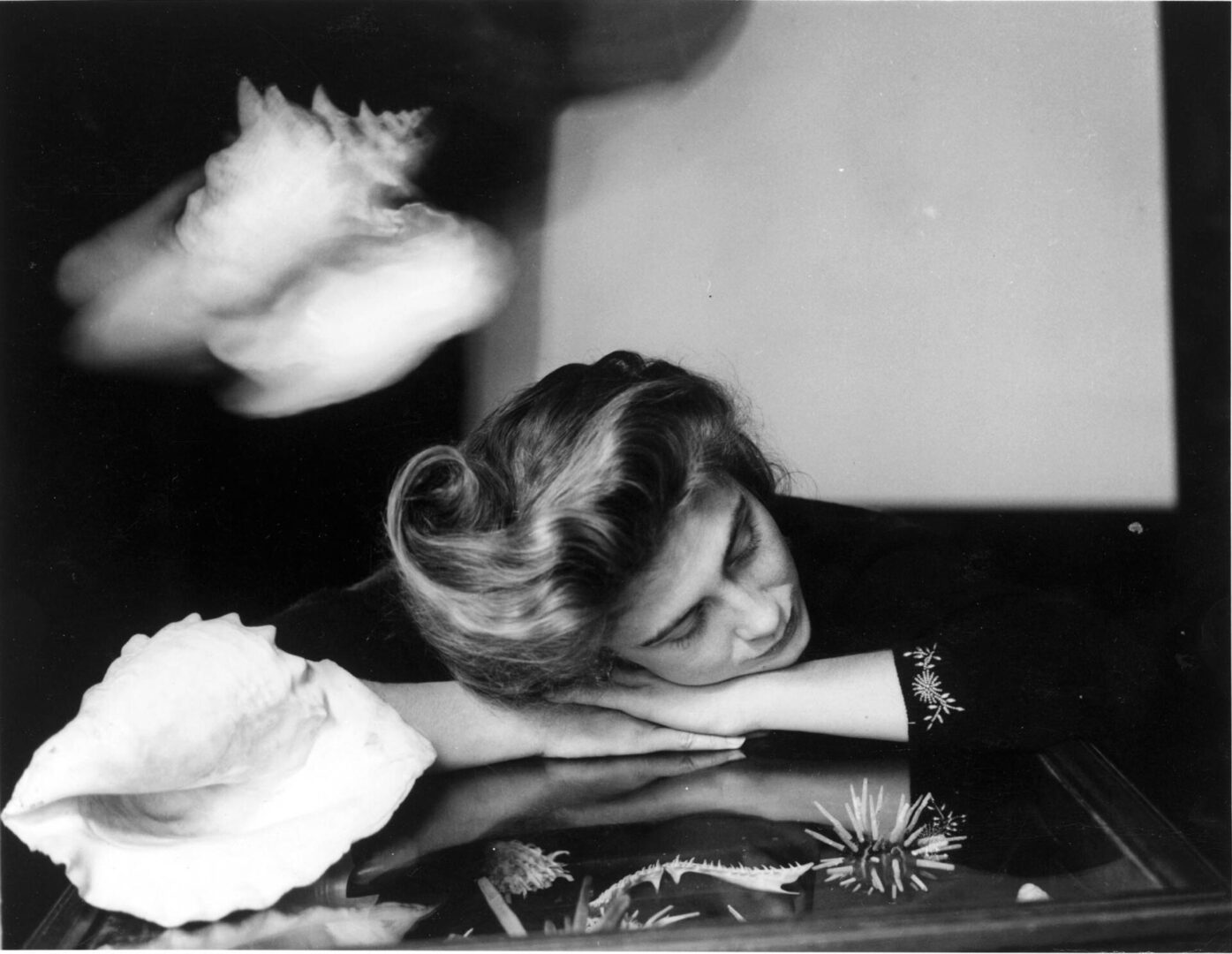
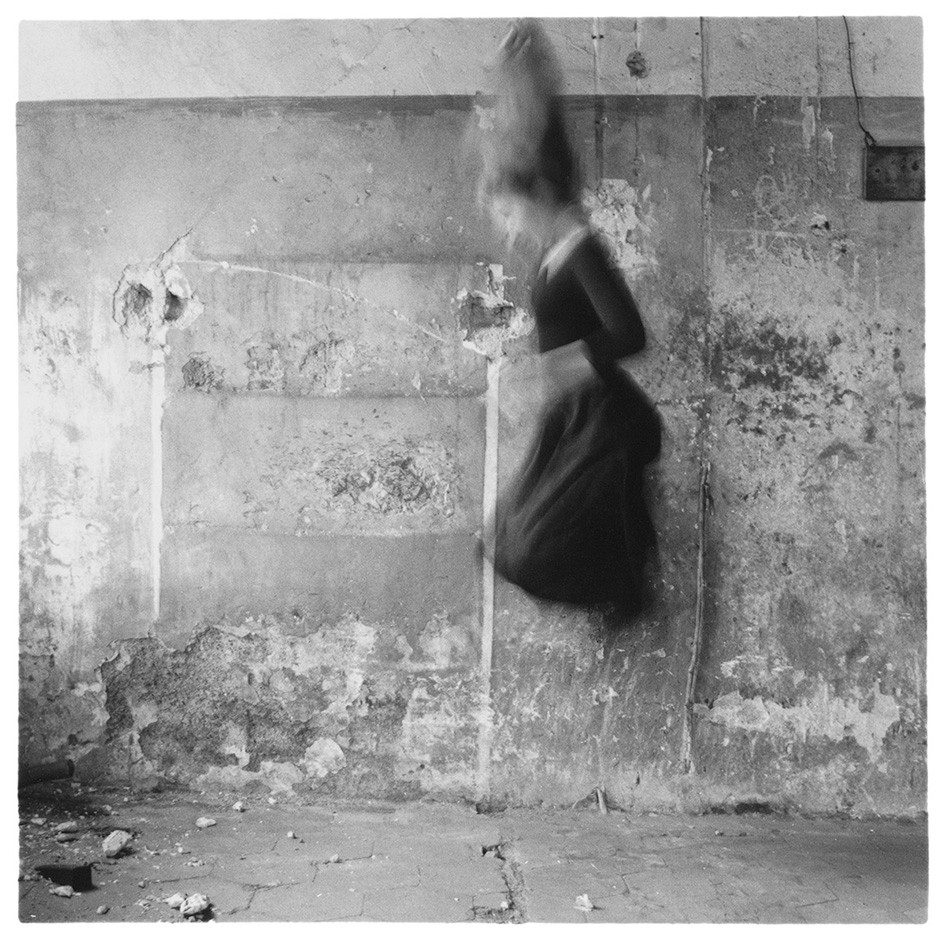
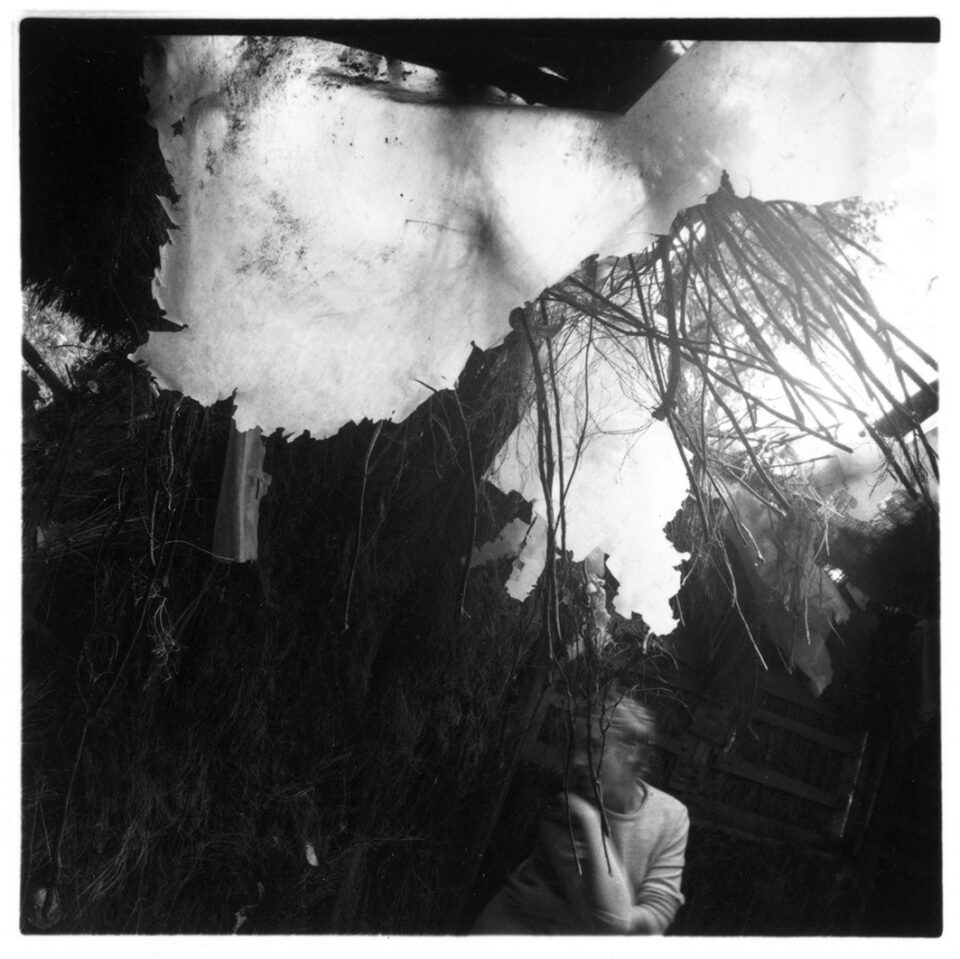
Francesca Woodman’s (1958–1981) photographic career spanned less than a decade. Yet, during that time, she created some of the best-known self-portraits of the 20th century. The majority of Woodman’s scenes unfold within empty interior spaces, illuminated by shafts of natural light or mirrored surfaces. The artist is usually the sole subject; sometimes she appears nude, other times clothed or shrouded. She might be partially hidden by furniture, appear to be suspended in a doorframe, or lie on the ground. “Haunting” is one of the words most-used to describe her images: they are often blurred, employing long exposure techniques and a black-and-white palette. Woodman operated on both sides of the camera, taking an approach that is compared to Cindy Sherman, Claude Cahun, Nan Goldin, Sophie Calle and Zanele Muholi.
This spring, Gagosian in Rome presents an exhibition of nearly 50 Woodman prints, many of which have never been exhibited previously. The show focuses on Woodman’s connection to Surrealism, a movement the artist studied at the Rhode Island School of Design. Her notebooks contain many references to its ideas; she was intrigued by the Surrealists’ use of allegory, language and ordinary items to express the uncanny. Woodman regarded André Breton – who co-founded the movement – as an influence. When talking about his book Nadja (1928), she said: “[Breton] picks out the allusions and enigmatic details of some rather ordinary unmysterious snapshots and elaborates them into a story. I’d like my photographs to condense experience.” Surrealist motifs appear across her compositions, in the form of symbolic everyday objects – eggs, gloves, masks, seashells, teacups, fruit and fish. The results are beautiful yet unsettling.
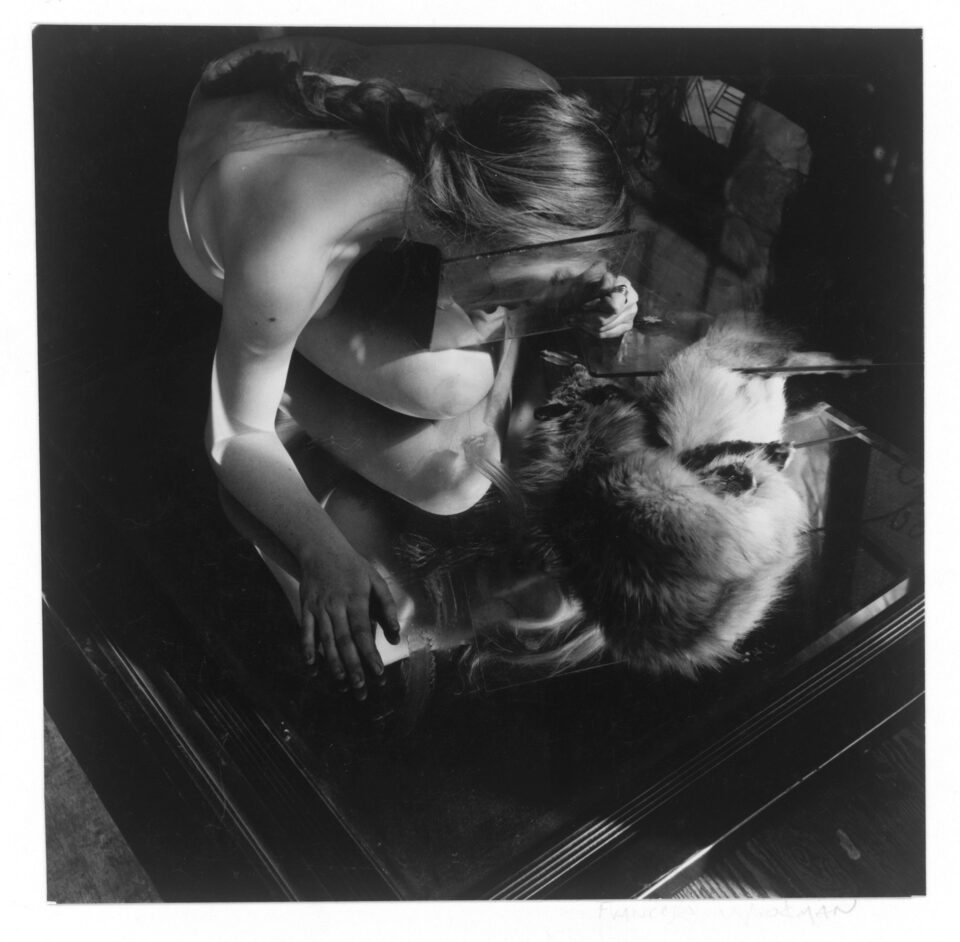
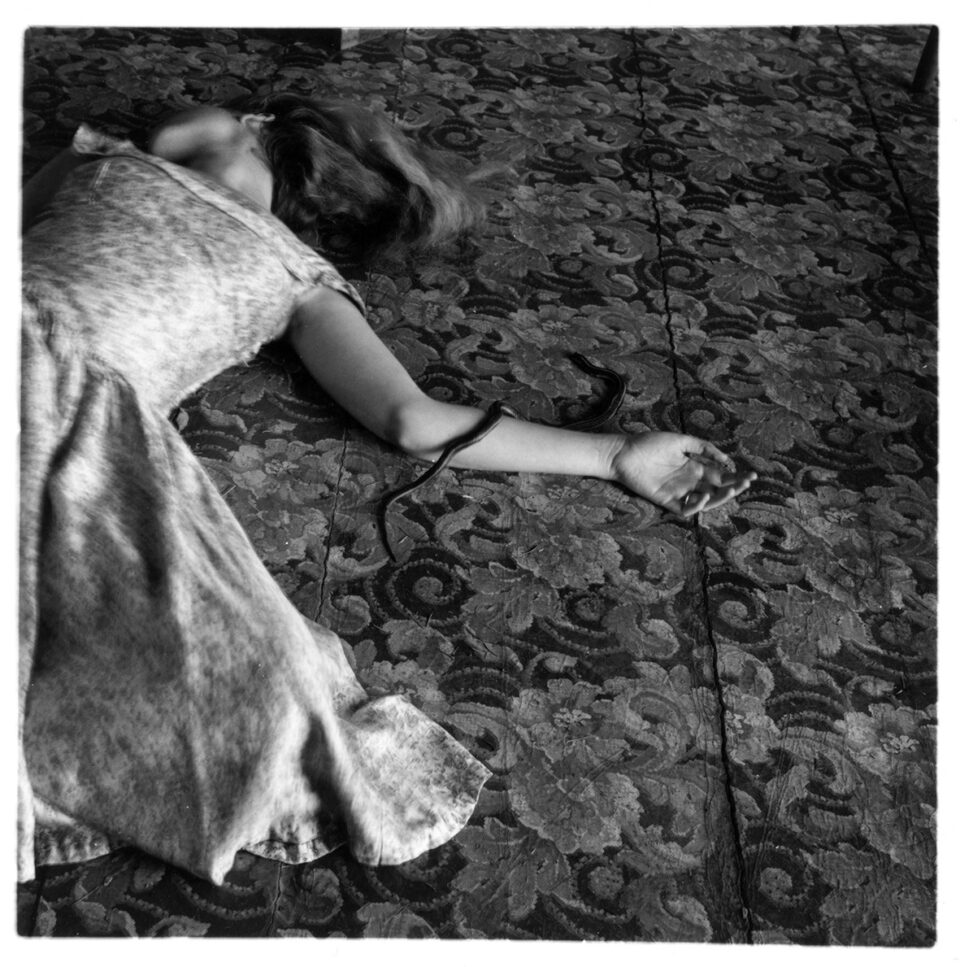
As art historian Alyce Mahon says: “Objects are not owned but are malleable in Woodman’s work, serving to bring the surreal into the lived space, whether it be the studio, an abandoned house, or nature. In this way their usefulness takes on a new understanding: they morph into vessels for novel encounters between strangers or strange things.” Ideas of transformation and the malleability of identity are key to understanding Woodman’s oeuvre. It is filled with dreamlike and imaginary scenes, staged and shaped by lighting, location, props and clothing. Other photographs, many of which are on view at Gagosian, picture the female figure manipulated in unusual ways; Woodman draped eels and gar over her nude body, pinched her flesh with clothespins and or wrapped her legs with tape. The resulting images relate to Surrealist interests in dream imagery and fetishisation, whilst also suggesting parodies of the movement’s key tropes.
The name of the exhibition, Lately I Find a Sliver of Mirror Is Simply to Slice an Eyelid, refers to a particular photograph by Woodman, in which she captures hands holding a mirror fragment. At first read, the title evokes the shock of Luis Buñuel’s Un Chien Andalou (1929), a film that features the seminal, flinch-inducing Surrealist image of a razor cutting through a human eye. In her notebooks, however, Woodman connected the piece to a class on fairytales taught during her first year at RISD. She links the phrase to the fable of The Snow Queen, which imagines a mystical looking glass that distorts perceptions of beauty. Reflections recur throughout Gagosian’s show; additional works on view incorporate further mirrors and glass panes.
Lately I Find a Sliver of Mirror Is Simply to Slice an Eyelid offers a distinctive angle on Woodman’s work, situating her within the rich and much-discussed lineage of Surrealism. The influences are all there – the objects of Man Ray, André Breton’s mysterious narratives, Dora Maar’s interest in female subjects – yet, it’s important to remember that Woodman achieved something remarkable all by herself. She started taking photographs at just 13-years-old, and produced over 800 shots before her tragic death aged 22. Her style is uniquely her own, and will endure for generations to come. As Cindy Sherman said: “She had few boundaries and made art out of nothing: empty rooms with peeling wallpaper and just her figure.”
Lately I Find a Sliver of Mirror Is Simply to Slice an Eyelid is at Gagosian, Rome, from 29 April – 31 July.
Words: Eleanor Sutherland
Image Credits:
1. Francesca Woodman, Untitled, c. 1975–78. Lifetime gelatin silver print Image: 9 1/2 x 12 3/8 inches (24.1 x 31.275 cm) Sheet: 11 x 13 7/8 inches (27.9 x 35.243 cm) © Woodman Family Foundation/SIAE, Rome Courtesy the Foundation and Gagosian.
2. Francesca Woodman, Untitled or #4 from a Series “Dissection of a Portrait”, 1976. Lifetime gelatin silver print mounted on mat board Image: 5 13/16 x 5 13/16 inches (14.7 x 14.7 cm) Sheet: 5 13/16 x 5 13/16 inches (14.7 x 14.7 cm) Mat board: 14 x 11 inches (35.5 x 27.9 cm) © Woodman Family Foundation/SIAE, Rome Courtesy the Foundation and Gagosian.
3. Francesca Woodman, Untitled, c. 1977–78. Lifetime gelatin silver print Image: 4 1/4 x 4 1/4 inches (10.6 x 10.6 cm) Sheet: 9 3/8 x 7 inches (23.8 x 17.9 cm) © Woodman Family Foundation/SIAE, Rome Courtesy the Foundation and Gagosian.
4. Francesca Woodman, Untitled, c. 1975–78. Lifetime gelatin silver print Image: 5 5/8 x 5 3/4 inches (14.3 x 14.5 cm) Sheet: 10 x 8 inches (25.243 x 20.32 cm) © Woodman Family Foundation/SIAE, Rome Courtesy the Foundation and Gagosian.
5. Francesca Woodman, Untitled, 1978. Lifetime gelatin silver print Image: 4 5/8 x 4 5/8 inches (11.5 x 11.5 cm) Sheet: 9 3/8 x 7 inches (23.813 x 17.78 cm) © Woodman Family Foundation/SIAE, Rome Courtesy the Foundation and Gagosian.