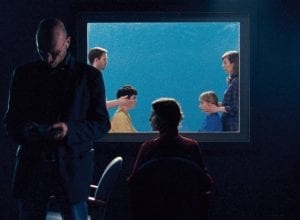
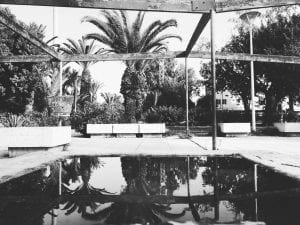
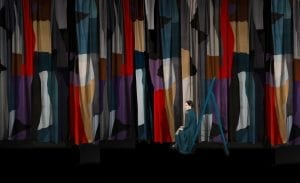
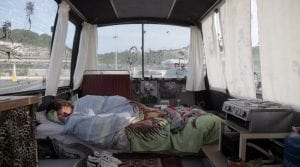
A Fake Moon rises over College Green, Bristol and invites you to pause and contemplate the passage of time: drawing a slightly stilted, yet wonderfully poetical arc across a Valentine’s Evening sky, it challenges you to question your perceptions of natural and constructed beauty, blurring the line between true and contrived experience. IBT13 is launched. Inhabiting the liminal space between performance and art, strongly concerned with time, the physical plane, and their interaction, the festival brings together a highly eclectic mix of international performance artists, with a variety of practices illuminating different aspects of time’s passing.
Interview with Maria Hayday of Scottish Dance Theatre
The Scottish Dance Theatre heads to London to present two premieres this March at The Place’s Robin Howard Dance Theatre. Running 7 – 8 March, the company perform two new works by international choreographers, Victor Quijada and Jo Strømgren. Currently directed by Fleur Darkin, the Scottish Dance Theatre showcase the strength of ten of their dancers in these productions. LA-born, Montreal-based Victor Quijada uses the Los Angeles street-dance culture of his youth in his new piece Second Coming, and Norwegian Jo Strømgren takes the dancers on a wild journey through the darkest, coldest season in Winter, Again, set to songs from Schubert’s Eine Winterreise. Aesthetica speaks to Maria Hayday, a member of the cast about the two productions and her work with the company.
5 Exhibitions to See this Weekend
The weekend is a great time to leisurely enjoy art. At Aesthetica we have compiled some of the best current exhibitions for you to enjoy this weekend. From Paris to New York, we take a moment to consider the contemporary art that is bound to inspire. Starting with Linder Sterling at The Musée d’Art Moderne de la Ville de Paris, read all about the top five experiences of art across the world.
On Creating Reality by Andy Kaufman at Maccarone Gallery, New York
Andy Kaufman was one of those mercurial types that we commonly refer to as a ‘genius’. This is owing to his ability to realise, beyond human experience, a new way to practice his craft. For Andy it was performance. Comedy, or its absence, is what he was engaged with. Practiced contumaciousness would be a more prone title, since his act was meant to travesty comedic assumptions. And since most people are familiar with his legendary acts there is no need to untangle the knotted routines that made him famous (Intergender wrestling, Tony Clifton, readings of the Great Gatsby, etc.). But what should be done, and what Maccarone Gallery in New York has attempted to do, is to give his work an anthropological basis in the ecclesia of performance. On Creating Reality by Andy Kaufman, on view at Maccarone Gallery through 16 February, is an attempt at just this. The artifacts that helped shape his singular persona are displayed as an indication that there is more than borderline psychosis involved in his difficult fabrications.
Aurélien Froment: 9 Intervals at Mother’s Tankstation, Dublin
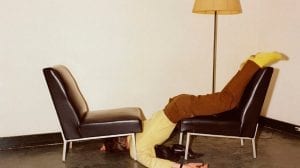
9 Intervals is about dialogue. Dialogue between juxtaposing images, presented on two screens playing in tandem across the walls of Mother’s Tankstation’s gallery; dialogue between image and text, as omnipresent voice-overs talk us calmly through each and every shot. The disparate images seem mostly to be linked to the concept of posture, and particularly seated posture.
Review of Estrangement: Fatma Bucak, Larisa Daiga, Evariste Maïga, Samuel Williams
Estrangement presents four emerging artists whose practices and nationalities choreograph a sly line between identity, economy, politics and video art history. Samuel Williams’ Natural Habitat sees video cameras mounted on rubber tubes, attached to portable trolleys or on draw strings, being pulled, floated or spun across a landscape and a lake. He works with the limits of time and materials – inflexibility and inevitability. But he also takes advantage of these constraints, improvising temporary pieces in a series of Twenty Second Sculptures made with the materials and objects to hand. His work has echoes of Fischli/Weiss’ The Way Things Go chain reaction video and American artist Tom Marioni’s One Second and Sixty Second Sculptures.
Aesthetica Issue 51 Out Now
Inside this issue, we start with Abraham Cruzvillegas: The Autoconstrucción Suites, a major exhibition opening at the Walker Art Center that features 35 individual sculptures and installations, along with his recent experiments in video, film and performance. We also look at the latest show to open at the Hayward Gallery, London, Light Show, which is a comprehensive survey of artists who use light as a material. David Bowie is opens at the V&A and is the first major retrospective of Bowie’s significant impact upon the world of visual art and design. Thomas Zanon-Larcher’s Falling: A Part blurs the lines between fashion and fine art photography, using cinema as its reference point. In photography, Garry Winogrand is widely recognised as one of America’s finest photographers, and his retrospective opens at SFMOMA, highlighting 25 years of the artist’s career. Cuba is the subject for the latest exhibition to open at Michael Hoppen Gallery, London, which showcases four decades of Michael Eastman’s work. We also introduce the works of Marquis Montes, a Montreal-based photographic duo, as well as Kevin Cooley, whose use of light creates intense drama.
Joy Division’s Peter Hook and Sonic Youth’s Kim Gordon at MCA Chicago
Joy Division’s bass guitarist Peter Hook is in artist conversation at the MCA on Tuesday 5 February. Reflecting on the band he helped co-found and his new book Unknown Pleasures: Inside Joy Division. Covering the band’s friendships and fallouts, their rehearsals and recording sessions, Hook gives a truly fascinating insight, as only an insider can, into the larger-than-life characters that formed a vital part of the Joy Division legend. The conversation is led by Joe Shanahan who booked Peter Hook (with New Order) for their first Chicago appearance at The Metro 30 years ago.
The Ultimate Form is a live action response to Barbara Hepworth’s work. Primarily produced by Linder Sterling, the performance is a unique collaboration between fashion designer Pam Hogg, Northern Ballet choreographer Kenneth Tindall and composer Stuart McCallum. Sterling has been working with collages for over three decades, and in The Ultimate Form she presents a “living collage” in the innovative combination of artistic skills employed. The Ultimate Form Trailer
Frieze New York 2013: Projects Announced
Today Frieze announced that the Frieze Projects programme of specially commissioned works will be realised at Frieze New York, 2013 from 10 until 13 May and will present over 180 of the world’s leading galleries. The fair is located in the unique setting of Randall’s Island Park, overlooking the East River. The five artists participating in the Frieze Projects program this year are: Liz Glynn, Maria Loboda, Mateo Tannatt, Andra Ursuta and Marianne Vitale.
Review of Jonas Mekas, London
In 1999, Jonas Mekas, the Lithuanian-born American film-maker, artist and poet, wrote, “I am a film-maker and a poet / I am a huge image projector / I make up, in my mind – or is it in my heart? – images, all the time… Some images I pick up from the ‘real’ world / and I film them; some others come from much deeper / and I do not have any control of them.” How was it possible that Mekas identified and defined his work so thoroughly yet so plainly? How was it possible that despite all the cruelty he witnessed in this world he succeeded in becoming and remaining a productive, self-assured and constructive artist?
Nothing to declare? World maps of art since ’89 at Akademie der Künste in Berlin
Nothing to declare? World maps of art since ’89, is the new documentary project scale exhibition devoted to the global processes of change in the art world since 1989, opening on 1 February at Akademie der Künste. The geopolitical change that took place in 1989 ushered in an era of worldwide biennales, whose geography bid farewell to Western Art, with its old contradiction between the centre and the periphery. With this theme as an art metropolis Berlin presents the world in the context of a reorganisation of the art scenes.